Goblins
Vainqueur the DragonGoblins occupy a paradoxical place in Vainqueur Knightsbane’s world: they are treated as a disposable species, yet they are also the practical foundation of his hoard, security, and household. Their repeated flight, recruitment, labor, and terror reveal how Vainqueur Knightsbane converts frightened creatures into an improvised institution of service while continuing to regard them as potential food.
Early Role as Mountain Guards
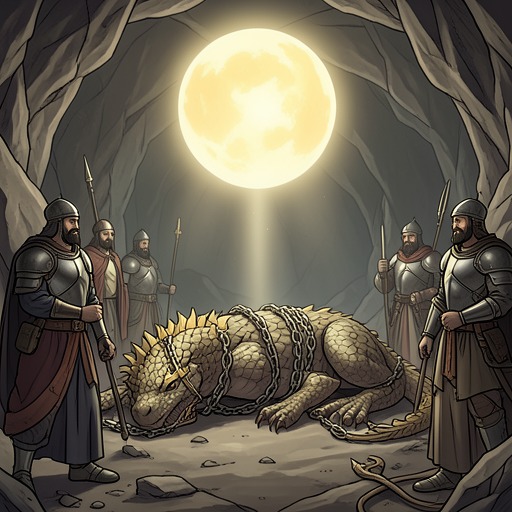
When Vainqueur Knightsbane awakens in his cave in the Albain Mountains, he expects the goblins he once permitted to live nearby to be guarding his treasure. Instead, the only apparent servant cleaning the Silver Rapier is Victor Dalton, a human thief disguised by the confusion of the lair. The dragon realizes that his supposed goblin watch has vanished, and immediately wonders whether the guards fled or were killed. Their absence is not merely a missing detail in his household: it leaves his hoard exposed and forces him to confront how little control his long sleep has preserved.
Victor Dalton explains that there has been no goblin activity in the mountains for decades. The goblins fled Barsino’s Great March through the Albain Mountains twenty years earlier, and Vainqueur Knightsbane’s senses confirm that no goblin scent has remained around the lair for at least ten years. The scene turns the dragon’s memory of loyal sentinels into an outdated assumption. He had imagined a continuing chain of service, but the local population had already been displaced before his awakening.
The goblins’ disappearance also shapes the Silver Rapier commission. Louise de Carabas offers a reward of one thousand gold pieces for the family weapon, believing it was last held by goblins in the Albain Mountains. Victor Dalton accepts the task partly because he expects easy money and a chance to scout the Carabas estate. The commission preserves the old association between goblins and the lost sword, even though the creatures themselves are no longer present to explain what happened to it.
Servitude Under Vainqueur Knightsbane
The narrative repeatedly places Goblins within Vainqueur Knightsbane’s hierarchy of usefulness and consumption. He calls Victor Dalton a minion and later defines minions as beings who may be eaten if the dragon and his chief of staff lack other food. Although Vainqueur Knightsbane describes Victor Dalton as almost an honorary part of his hoard, the same logic applies to the goblins: service grants proximity and value, but never guarantees safety. Their labor is therefore both social and zoological, measured against the dragon’s food chain rather than against an equal contract.
The goblins’ subordination is contrasted with Vainqueur Knightsbane’s general claim that intelligent monsters can be integrated into his service. Victor Dalton’s Monster Squire class grants him the Monster Kin perk, described as making him friendly with monsters, after Vainqueur Knightsbane promotes him to chief of staff and living signature. Later, Victor Dalton earns seven additional levels in Monster Squire for leading monsters to victory against superior opponents. Goblins are part of the population that makes this monster-centered structure possible, but the game-like rewards attach to the human administrator and commander rather than to the goblin laborers themselves.
Vainqueur Knightsbane’s recruitment practices are also openly coercive. When werewolves survive an encounter that he considers costly because dead enemies would have yielded more treasure, he orders them to become his new minions as an apology. The same principle governs the goblins more broadly: continued life is presented as compensation for obedience, and refusal risks being reclassified as food. Their service is not founded on trust but on the dragon’s power to define survival as a reward.
Flight, Replacement, and the New Settlement
After the old goblin guards disappear, Vainqueur Knightsbane relies increasingly on other monster populations, especially Kobolds. He considers the fleeing goblins cowards and concludes that Kobolds solve the practical problems of minion management better than the former guards did. Yet the later history of his domain demonstrates that Goblins are not permanently excluded. They return as the builders and inhabitants of a new settlement surrounding his lair.
That later lair lies beneath a grass hill in a valley that human settlers have given Vainqueur Knightsbane after he ordered them to do so. Around the cave, his goblin minions construct a small village of wood and mud. They breed rapidly, almost as quickly as Vainqueur Knightsbane consumes them when cattle run out, and survive on vegetables that the dragon disdains. The village therefore functions as both a community and a replenishable resource. Its food production sustains the goblins, while the goblins’ labor sustains the dragon’s broader household; the possibility of their consumption remains built into the settlement’s economy.
The contrast with the abandoned mountain lair is significant. Earlier, Goblins flee from a dragon whose absence had lasted fifty years and whose former protection no longer exists. Later, they occupy a settlement directly around him, but their apparent permanence does not indicate emancipation. They live near the cave because they have been incorporated into Vainqueur Knightsbane’s domain, where construction, agriculture, guard duty, and personal service all answer to his appetite and temperament.
Household Labor and the Chief of Staff
Goblins eventually perform the most immediate domestic functions in Vainqueur Knightsbane’s household. When the dragon wakes hungry, three greenish, childlike Goblins are sleeping on guard duty at the entrance. His landing throws them against the cave wall, and his roar leaves them terrified. Nevertheless, they report that they have caught a thief for him, demonstrating that even frightened and incompetent guards can still be useful within his system.
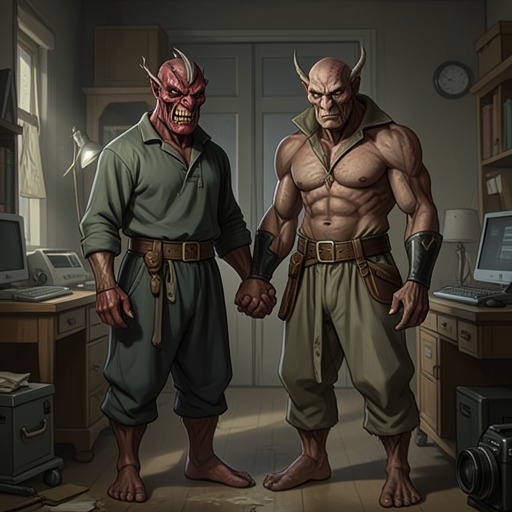
The captured thief is a thin Ratling, whom Vainqueur Knightsbane judges disappointing because he would have preferred a fat breakfast. The dragon then asks for his chief of staff, but one Goblin claims the position because the human administrator is absent. Vainqueur Knightsbane cannot distinguish the Goblin from the others and orders him to become more remarkable, warning that otherwise the dragon may confuse his place in the food chain. The demand is comic, but it also exposes the fragility of Goblin identity under his rule: individual service is expected, while individuality itself is barely recognized.
The chief of staff is instructed to bring the captive and the dragon’s large cowskin grocery bag. The Goblins understand the order and hurry up the hill, restraining the Ratling with ropes while carrying the bag. Their work is precise enough to preserve Vainqueur Knightsbane’s routines, even though their fear is visible and their master treats the entire expedition as grocery shopping. The domestic image makes the hierarchy especially stark: a village of laborers, a chief of staff, guards, a prisoner, and a dragon-sized bag all operate as parts of one household organized around consumption.
Moral and Narrative Significance
Goblins help define the novel’s satirical treatment of species hierarchy. Vainqueur Knightsbane speaks of a food chain in which preciousness determines who may consume whom, and he places minions below himself as emergency rations. He can call a servant nearly part of his hoard while still reserving the right to eat that servant. The Goblins embody the contradiction most visibly because they are simultaneously guards, builders, farmers, servants, and food supplies.
The text also places their treatment beside broader arguments about sentience. Jolie states that manlings and other sentient beings have souls and that eating or abducting them is morally wrong, while Vainqueur Knightsbane exempts elves from the mercy he is asked to extend to humans. His selective ethics are matched by his treatment of Goblins: their intelligence and collective labor make them valuable, but their personhood never overrides his appetite. Against the exterminatory proposal of a Fomor who promises fairy gold and mortal flesh, Vainqueur Knightsbane refuses because eliminating the mortal races would deprive him of coins and princesses. His objection is logistical and self-interested rather than humanitarian, and Goblins remain inside that same instrumental worldview.
As a recurring group, Goblins therefore register the consequences of Vainqueur Knightsbane’s rule more clearly than his grand declarations do. They flee when his protection disappears, return when his territory expands, build a village around his cave, guard him despite terror, and carry out his errands under threat of consumption. Their history is neither a simple rise nor a simple decline. It is a cycle of displacement and reabsorption in which survival depends on becoming useful to a dragon who cannot consistently separate loyalty, ownership, and hunger.